
Tús an tionscail
Áit / Scéal / Tús an tionscail / How to Pick the Right Commercial Ice Maker for Your Business — A No-Fluff Buyer's Guide
2026-06-10
For any business that serves food or drinks — a restaurant, bar, hotel, healthcare facility, convenience store, or catering operation — ice is not a background detail. It's a product your customers interact with directly, and a shortage of it during a busy shift can bring service to a halt faster than almost any other equipment failure. A commercial ice maker is one of the most operationally critical pieces of equipment in a foodservice environment, yet it's frequently chosen based on price alone without considering the factors that actually determine whether the machine will meet daily demand reliably over its service life.
The commercial ice machine market covers a wide range of machine types, ice shapes, production capacities, and installation configurations. A modular ice maker head paired with a large bin is the right solution for a high-volume bar; a self-contained undercounter commercial ice maker makes more sense for a small café with limited space; a nugget ice machine is essential for a healthcare facility or a business where chewable ice is part of the customer experience. Getting these decisions right from the start avoids the costly outcome of replacing equipment that was never correctly specified in the first place.
Before looking at capacity or brand, the first decision is machine type — which determines installation footprint, production volume potential, and operational flexibility. There are three primary configurations used in commercial settings, each with a distinct use case.
A modular commercial ice maker — also called an ice maker head — is the production unit only, designed to be placed on top of a separate ice storage bin or a dispenser unit. The machine itself produces ice and drops it into the bin below, but has no storage capacity of its own. Modular units are available in widths ranging from 22 inches to 48 inches and can produce anywhere from 250 to over 2,000 pounds of ice per day depending on the model. This configuration is the most common choice for high-volume operations — restaurants, hotel bars, large cafeterias — where daily ice demand is substantial and having a large, separate storage bin ensures ice is always available even during the busiest periods. Modular machines also allow flexibility: as demand grows, the ice maker head can be upgraded to a higher-capacity model while keeping the existing bin.
A self-contained commercial ice machine integrates both the production mechanism and the storage bin into a single unit. These machines are compact — many are designed for undercounter installation at standard counter height — and produce a more modest daily volume, typically between 50 and 400 pounds per day. They are ideal for smaller operations where counter space is limited and daily ice demand doesn't exceed what a single compact machine can produce and store. Coffee shops, small bars, office pantries, and back-of-house prep stations are typical environments where a self-contained commercial ice maker fits well. The trade-off is that once demand grows beyond the machine's capacity, the only option is replacement rather than upgrading components.
Countertop commercial ice dispensers are compact, standalone units that produce ice and dispense it directly — either into a cup via a lever or button mechanism, or into a bin for manual scooping. These are widely used in healthcare settings, hotel lobbies, and convenience stores where sanitation is paramount and ice should never be handled by hand. Many countertop commercial ice machines produce nugget ice specifically — a soft, chewable, compacted flake ice that has become highly popular in both healthcare and foodservice for its texture and ability to absorb drink flavor. Brands like Scotsman, Hoshizaki, and Manitowoc produce dedicated commercial nugget ice machines in both countertop and floor-standing configurations.
The shape of ice a commercial ice maker produces is not just an aesthetic detail — it directly affects drink quality, customer experience, and ice consumption rate. Different operations require different ice shapes, and choosing a machine that produces the wrong type is a surprisingly common specification error.
| Ice Shape | Description | Melt Rate | Best For |
| Full Cube | Solid, clear, approximately 1¼" cube | Slow | Cocktails, spirits, upscale dining, bagging |
| Half Cube | Smaller solid cube, most widely used shape | Moderate | Fountain drinks, general bar use, fast food |
| Nugget (Sonic Ice) | Soft, chewable, compressed flake ice | Fast | Healthcare, blended drinks, fast casual dining |
| Flake | Thin, small irregular pieces; moldable | Very Fast | Food display, seafood beds, produce display, healthcare therapy |
| Crescent | Half-moon shaped, prevents splash | Moderate | Beverage dispensers, cafeteria drink stations |
| Gourmet / Octagon | Clear, large, slow-melting specialty shape | Very Slow | Premium cocktail bars, whiskey service |
Half cube ice — also called dice ice — is the most versatile and most widely used shape in commercial foodservice because it fits standard cup sizes well, fills efficiently, and has a moderate melt rate that keeps drinks cold without watering them down too quickly. Full cube ice is preferred in higher-end establishments where drink quality and presentation matter, and where the slower melt rate is a deliberate choice. Nugget ice has seen a significant surge in popularity over the past decade, driven partly by the "Sonic ice" trend and partly by its healthcare applications, where soft ice reduces injury risk for patients.
One of the most common and costly mistakes when purchasing a commercial ice maker is underestimating daily ice demand. A machine that cannot keep up with peak-hour demand creates operational problems immediately, while a dramatically oversized machine wastes energy and purchase budget. Calculating the right production capacity requires accounting for the type of operation, the number of covers or customers served daily, and the specific uses of ice in the business.
The foodservice industry uses standard per-person ice consumption estimates as a starting point for capacity calculations. These are rough guidelines — actual usage varies based on climate, drink menu, and service style — but they provide a useful baseline:
Once you have a raw daily demand figure, add a buffer of at least 20% to account for peak days, hot weather (which significantly increases ice demand in warm climates), and the fact that commercial ice maker production ratings are measured at ideal conditions — 70°F ambient air temperature and 50°F incoming water temperature. In a hot kitchen environment with warmer incoming water, a machine may produce 15–30% less than its rated capacity. Always size up rather than to the exact calculated need, and factor in ice storage bin capacity separately — the bin should hold at least one full day's production to cover off-peak production times.
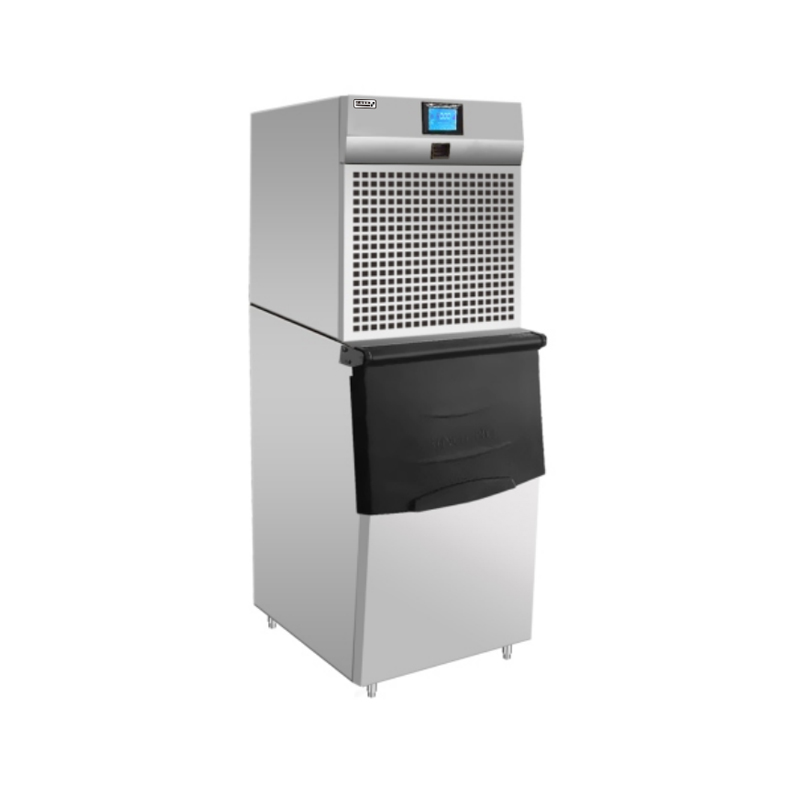
Every commercial ice machine must dissipate the heat generated during the refrigeration cycle. The method used to do this — air cooling, water cooling, or remote condensing — has significant implications for installation requirements, energy and water costs, and where the machine can be placed.
Air-cooled commercial ice makers use a condenser fan to draw ambient air across the condenser coils and exhaust the heat into the surrounding room. This is by far the most common configuration — it requires no additional water lines beyond the standard inlet, is less expensive to purchase, and is simpler to install. The limitation is that it exhausts heat into the room, which can noticeably raise ambient temperature in a small, enclosed space. Air-cooled commercial ice machines also perform less efficiently in hot environments — a machine in a 90°F kitchen will produce significantly less ice than one in a 70°F room. Adequate ventilation clearance (typically 6 inches on the sides and top of the unit) is essential for proper operation.
Water-cooled commercial ice makers use a water loop to carry heat away from the condenser rather than dissipating it into the air. They are more efficient in hot ambient conditions and produce more consistent ice output regardless of room temperature. The significant downside is water consumption — a water-cooled ice machine uses considerably more water than an air-cooled unit of equivalent capacity, which adds to operating costs and is an environmental concern. In many regions, water-cooled commercial ice machines are prohibited or discouraged by local water conservation regulations. They remain appropriate in specific situations — such as installations in very hot, poorly ventilated mechanical rooms — but are not the default recommendation for most commercial applications.
Remote-cooled commercial ice machines separate the condenser from the ice maker head and place it in a remote location — typically on the rooftop or in an external mechanical room. The refrigerant lines run between the two units. This configuration eliminates heat exhaust from the kitchen or bar environment entirely, making it ideal for tight, hot spaces where air-cooling would be impractical. Remote condensing systems also tend to run quieter. The trade-off is a more complex and expensive installation — refrigerant line runs must be carefully sized and installed by a licensed refrigeration technician, and the remote condenser requires its own mounting location and access for maintenance.
Beyond capacity and ice type, several specific features separate commercial ice machines that perform reliably over many years from those that require frequent service calls and early replacement. These are the details worth examining closely before purchasing.
The commercial ice machine market is dominated by a handful of major manufacturers with decades of industry presence. Understanding what each brand is recognized for helps narrow the selection to machines that match the priorities of a specific operation.
| Brand | Known For | Ice Types | Best Fit |
| Manitowoc | Reliability, wide model range, NEO series technology | Cube, nugget, flake | Restaurants, bars, hotels |
| Hoshizaki | Premium build quality, crescent cube, long service life | Crescent cube, flake | High-end foodservice, sushi bars, seafood |
| Scotsman | Nugget ice innovation, healthcare focus, antimicrobial features | Nugget, cube, flake | Healthcare, fast casual, convenience |
| Ice-O-Matic | Value pricing, simple maintenance, PURE ICE technology | Cube, pearl (nugget), flake | Budget-conscious operations, small restaurants |
| Follett | Nugget ice expertise, dispensing systems, healthcare | Nugget (chewblet) | Hospitals, universities, self-serve dispensing |
| Kold-Draft | Premium full-cube clarity, cocktail bar focus | Full cube | Upscale cocktail bars, spirits service |
Manitowoc and Hoshizaki together account for a large share of the commercial ice maker market in North America, and both have extensive service networks — an important practical consideration when evaluating brands, since a machine that breaks down and takes three weeks to get parts for costs far more in lost productivity than the price difference between a well-supported brand and a lesser-known one.
Installing a commercial ice machine involves more than finding a spot and plugging it in. Proper installation requires coordinating plumbing, electrical, and sometimes refrigeration work, and shortcuts at this stage cause problems that persist for the life of the machine.
A commercial ice maker that is not maintained on a regular schedule will degrade in production capacity, develop sanitation problems, and fail prematurely. The maintenance tasks for commercial ice machines are not particularly complex, but they must be done consistently to keep the machine producing clean, properly formed ice and to avoid the expensive repairs that result from neglect.
The condenser filter or coil on air-cooled commercial ice makers should be inspected monthly and cleaned as needed — in dusty kitchen environments, the condenser can become clogged enough to reduce efficiency within a few weeks. Cleaning involves brushing or vacuuming dust and grease from the condenser fins and wiping down the exterior. The water filtration system should be monitored for flow rate and replaced on schedule — a clogged filter restricts water flow and starves the machine, causing thin, misshapen ice and reduced daily output. Inspect the bin interior for any signs of pink or black slime growth quarterly and clean with an ice machine sanitizer if detected.
Commercial ice machine manufacturers and food safety authorities — including the FDA and NSF International — recommend a full descaling and sanitizing service at least twice per year, and more frequently in hard water areas or high-demand operations. This involves emptying the bin, removing all ice, running a descaling cycle with an approved ice machine cleaner to remove mineral scale from the evaporator and water distribution system, and then running a sanitizing solution through the system to kill bacteria and mold. Many operations schedule this service through a commercial refrigeration contractor who can also inspect the refrigerant system, check evaporator plate condition, and verify that the machine is producing to rated capacity.
The purchase price of a commercial ice machine is only one part of the total cost of ownership. Energy consumption, water usage, filter replacement, and periodic service are recurring costs that vary significantly between machine types and sizes — and they add up considerably over a typical 7-to-10-year equipment lifespan.
| Machine Type / Capacity | Purchase Price Range | Avg. Daily Production | Best For |
| Undercounter self-contained | $1,500 – $4,000 | 50 – 200 lbs/day | Small cafés, offices, bars |
| Mid-size modular head + bin | $3,500 – $7,500 | 300 – 800 lbs/day | Restaurants, mid-size bars |
| High-capacity modular head + bin | $6,000 – $15,000+ | 800 – 2,000+ lbs/day | Hotels, large restaurants, stadiums |
| Countertop nugget dispenser | $2,500 – $6,000 | 50 – 400 lbs/day | Healthcare, self-serve stations |
| Flake ice machine | $3,000 – $9,000 | 400 – 1,500 lbs/day | Seafood, produce display, healthcare |
For businesses that are not ready to commit to a purchase — or that want to conserve capital — commercial ice machine leasing and rental programs are widely available through equipment dealers and specialty foodservice finance companies. Monthly lease payments for a mid-size commercial ice maker typically run between $75 and $200 per month depending on the machine and term length, and many leasing programs include preventive maintenance service in the contract. This can be a cost-effective option for new businesses that need to preserve cash flow, or for operators who want to include maintenance costs in a predictable monthly budget rather than treating them as unplanned expenses.

Bóthar Uimh.
Call Us: +86-18217685733 / +86-18221531811
E-mail: [email protected] / [email protected]
Cóipcheart © Jiangsu Bingluo Refrigeration Equipment Co., Ltd. Gach ceart ar cosaint. Réitigh Trealamh Cuisniúcháin Tráchtála $ $



